
Level 3 Health and Safety Training in the Workplace

- Access
- Lifetime
- Assistance
- Expert Tutor Support
- Flexibility
- Learn Anytime, Anywhere
Overview
Level 3 Health and Safety Training in the Workplace
Get Ready To Build your workplace health and safety skills
Gain essential workplace safety knowledge, understand hazard prevention and risk control practices, and build a strong foundation for career opportunities involving health and safety responsibilities across various industries!
✅ Master Workplace Health & Safety Fundamentals — Learn essential health and safety principles, workplace safety management, occupational health, and common hazard prevention practices.
✅ Develop Risk Assessment & Hazard Control Knowledge — Explore workplace hazards, risk control measures, personal protective equipment (PPE), work equipment safety, manual handling, and safe practices for work at height.
✅ Build Fire, Electrical & Incident Safety Knowledge — Understand fire and electrical safety, chemical and biological hazards, workplace first aid, accident and incident reporting, RIDDOR requirements, and HACCP food safety principles.
✅ Explore Career Opportunities — Build industry-relevant knowledge to support roles involving workplace health and safety responsibilities across construction, manufacturing, engineering, hospitality, warehouses, offices, and healthcare environments.
Course Overview
Explore the principles of workplace health and safety with this Level 3 Health and Safety Training in the Workplace course. The programme introduces health and safety management, workplace hazards and the control measures used to support safer working environments.
Across 20 modules, you will examine a range of workplace safety considerations, including fire and electrical safety, engineering hazards, working at height, manual handling and the safe use and maintenance of work equipment. The curriculum also explores occupational health, personal protective equipment, workplace hygiene and the risks associated with chemical and biological hazards.
Further topics include occupational diseases, mental healthcare, public health and food safety principles, including HACCP. You will also study workplace first aid legislation and the principles of accident and incident reporting, including relevant RIDDOR requirements.
Designed for learners interested in workplace safety responsibilities, this course provides an overview of health and safety management, hazard control and reporting considerations across different working environments.
Key Curriculum Topics
-
Health and Safety Management: Explore workplace safety responsibilities and approaches to managing hazards.
-
Fire, Electrical and Equipment Safety: Understand safety considerations associated with fire, electricity and work equipment.
-
Occupational Health and PPE: Examine occupational health risks, workplace hygiene and the role of personal protective equipment.
-
Chemical and Biological Hazards: Explore the risks associated with hazardous substances and biological agents.
-
Working at Height and Manual Handling: Understand common workplace hazards and associated control measures.
-
Food Safety and HACCP: Introduce food safety principles relevant to applicable workplaces.
-
Accident Reporting and RIDDOR: Examine workplace incident reporting and relevant legal requirements.
Course Curriculum
Module 1: Health and Safety Management
This module introduces health and safety management and establishes a foundation for understanding workplace health and safety practices.
Main learning topics:
- Health and safety management
- Workplace safety
- Safety management
- Health and safety practices
Module 2: Engineering Safety
This module focuses on engineering safety and introduces safety considerations relevant to engineering and technical workplace environments.
Main learning topics:
- Engineering safety
- Workplace engineering hazards
- Engineering safety considerations
- Technical workplace safety
Module 3: Fire and Electrical Safety
This module covers fire and electrical safety, addressing two important areas of workplace risk and hazard awareness.
Main learning topics:
- Fire safety
- Electrical safety
- Fire hazards
- Electrical hazards
Module 4: Occupational Health and Personal Protective Equipment
This module explores occupational health and personal protective equipment, focusing on workplace health protection and PPE.
Main learning topics:
- Occupational health
- Personal protective equipment
- PPE
- Workplace health protection
Module 5: Mental Healthcare
This module introduces mental healthcare as part of the wider workplace health and safety curriculum.
Main learning topics:
- Mental healthcare
- Workplace health
- Mental health considerations
- Employee wellbeing
Module 6: Public Health
This module examines public health within the broader context of workplace health and safety.
Main learning topics:
- Public health
- Workplace health
- Health protection
- Public health considerations
Module 7: Working at Height – Hazards and Control
This module focuses on hazards associated with working at height and the control measures relevant to this workplace risk.
Main learning topics:
- Working at height
- Height-related hazards
- Hazard control
- Workplace safety controls
Module 8: Work Equipment Hazards and Control
This module examines hazards associated with work equipment and the controls used to manage those hazards.
Main learning topics:
- Work equipment
- Equipment hazards
- Hazard control
- Equipment safety
Module 9: Electrical Hazards and Control
This module provides focused coverage of electrical hazards and their control within workplace environments.
Main learning topics:
- Electrical hazards
- Electrical safety
- Hazard control
- Electrical risk management
Module 10: Chemical and Biological Health Hazards and Control
This module covers chemical and biological health hazards and the control of risks associated with these workplace hazards.
Main learning topics:
- Chemical health hazards
- Biological health hazards
- Hazard control
- Workplace health risks
Module 11: Reporting Accidents and Incidents at Work
This module focuses on reporting accidents and incidents at work and the importance of appropriate workplace reporting.
Main learning topics:
- Workplace accidents
- Workplace incidents
- Accident reporting
- Incident reporting
Module 12: Legal Framework (UK) for Workplace First Aid
This module introduces the UK legal framework relating to workplace first aid.
Main learning topics:
- UK workplace first aid
- Legal framework
- Workplace first aid
- First aid responsibilities
Module 13: Practice of Self-Hygiene
This module examines self-hygiene and its importance within workplace health and safety practices.
Main learning topics:
- Self-hygiene
- Hygiene practices
- Workplace hygiene
- Personal hygiene
Module 14: HACCP Food Safety
This module introduces HACCP food safety as an important component of workplace health and safety in food-related environments.
Main learning topics:
- HACCP
- Food safety
- Food safety practices
- Workplace food safety
Module 15: A Guide to Safe Manual Handling
This module focuses on safe manual handling and the management of risks associated with manual tasks.
Main learning topics:
- Manual handling
- Safe manual handling
- Manual handling risks
- Workplace safety
Module 16: Work Equipment Maintenance
This module explores work equipment maintenance and its relationship with safe equipment practices.
Main learning topics:
- Work equipment maintenance
- Equipment safety
- Maintenance practices
- Workplace equipment
Module 17: Occupational Diseases
This module examines occupational diseases and their relevance to workplace health.
Main learning topics:
- Occupational diseases
- Occupational health
- Workplace-related illness
- Workplace health risks
Module 18: Exposure to Mutagens, Biological Agents and Carcinogens
This module covers exposure to mutagens, biological agents and carcinogens as specific workplace health hazards.
Main learning topics:
- Mutagens
- Biological agents
- Carcinogens
- Workplace exposure
Module 19: Dangerous Occurrences
This module focuses on dangerous occurrences and their relevance to workplace health and safety management.
Main learning topics:
- Dangerous occurrences
- Workplace incidents
- Safety management
- Workplace hazards
Module 20: RIDDOR Report
This module introduces RIDDOR reporting and its relationship with workplace accident and incident management.
Main learning topics:
- RIDDOR
- RIDDOR reporting
- Workplace incidents
- Reportable occurrences
Who Is This Course For?
This course is suitable for employees who want to develop broader knowledge of workplace health and safety. It may be particularly relevant to staff working in environments where equipment, manual handling, fire, electricity, chemicals, biological agents or food safety form part of everyday operations.
Supervisors and managers may find the curriculum useful for developing awareness of workplace safety responsibilities, hazard controls, accident reporting, occupational health and equipment safety.
It can also suit workplace safety representatives and learners exploring health and safety-related career areas. The National Careers Service states that health and safety advisers develop policies designed to reduce workplace accidents, injuries and health issues, and may carry out inspections, risk assessments and accident investigations.
The course may be relevant across construction, engineering, manufacturing, hospitality, food production, warehouses, offices, healthcare and other working environments.
Learners searching for online health and safety courses for staff or a workplace health and safety course online can use the curriculum to develop broad subject knowledge before pursuing role-specific training.
Requirements
No formal entry requirements have been supplied for this course. Therefore, no specific previous qualification, GCSE, A-level, work experience or professional registration should be assumed as a course requirement.
Some specialist workplace health and safety roles require additional qualifications, professional training or experience. For example, the National Careers Service identifies university study, apprenticeships and professional-body training as possible routes into health and safety adviser roles.
Learners should therefore check the specific requirements of their intended occupation and employer separately.
Skills You Can Develop
Health and Safety Management — Develop knowledge of managing and understanding workplace health and safety.
Hazard Awareness — Build knowledge of workplace hazards involving fire, electricity, equipment, chemicals, biological agents and working at height.
Hazard Control Knowledge — Develop understanding of controls associated with working at height, work equipment, electrical hazards and chemical and biological hazards.
Occupational Health Awareness — Build knowledge of occupational health, occupational diseases and workplace health risks.
PPE Awareness — Develop understanding of personal protective equipment and its role in workplace health protection.
Accident and Incident Reporting — Develop knowledge of reporting accidents and incidents at work.
RIDDOR Reporting Knowledge — Understand the role of RIDDOR reporting within workplace incident management.
Manual Handling Safety — Develop knowledge of safe manual handling practices.
Equipment Safety Knowledge — Build understanding of work equipment hazards, controls and maintenance.
Food Safety Knowledge — Develop knowledge of HACCP food safety and self-hygiene.
Workplace First Aid Awareness — Develop knowledge of the UK legal framework for workplace first aid.
Chemical and Biological Hazard Awareness — Build knowledge relating to chemical hazards, biological agents, mutagens and carcinogens.
Learning Outcomes
- Understand the principles of health and safety management in the workplace.
- Identify key safety considerations associated with engineering environments.
- Explain important aspects of fire and electrical safety.
- Describe occupational health considerations and the role of personal protective equipment.
- Identify hazards associated with working at height and relevant control measures.
- Explain hazards and controls associated with work equipment, chemicals and biological agents.
- Describe the importance of reporting accidents and incidents at work.
- Recognise key considerations relating to manual handling, self-hygiene and HACCP food safety.
- Identify workplace health concerns including occupational diseases and exposure to mutagens, biological agents and carcinogens.
- Explain the purpose of dangerous-occurrence and RIDDOR reporting within workplace health and safety.
Career Paths
Health and Safety Adviser
Typical UK Salary: £26,000 to £48,000 per year, according to the National Careers Service.
How the course is relevant: The curriculum covers health and safety management, hazard control, occupational health, workplace incidents, RIDDOR, equipment safety and a broad range of workplace hazards. These subjects are relevant to the knowledge areas used in health and safety advising. However, specific health and safety adviser positions can require additional qualifications, experience and professional development.
Health and Safety Officer
Typical UK Salary: Salary varies according to employer, location, experience, sector and responsibilities.
How the course is relevant: The course covers workplace safety management, hazard control, accident reporting, occupational health, PPE, fire safety, electrical safety and other workplace safety topics. This knowledge may support learners interested in workplace safety responsibilities, although individual employers may require additional qualifications or experience.
Health and Safety Manager
Typical UK Salary: Salary varies according to employer, sector, location, experience and level of responsibility.
How the course is relevant: Health and safety management, hazard control, incident reporting, equipment safety, occupational health and workplace risk topics provide relevant subject knowledge for learners interested in progressing towards safety management responsibilities. Management-level positions may require additional qualifications and professional experience.
Environmental Health Practitioner
Typical UK Salary: £27,000 to £50,000 per year, according to the National Careers Service.
How the course is relevant: The curriculum includes public health, HACCP food safety, occupational health, chemical and biological hazards and workplace health. These topics overlap with areas relevant to environmental health. However, becoming an environmental health practitioner requires an appropriate professional education and qualification pathway, so this course should not be presented as a substitute for that route.
Salary figures are indicative rather than guaranteed. Actual earnings vary according to experience, location, employer, sector and job responsibilities.
FAQs
What is Level 3 Health and Safety Training in the Workplace?
Level 3 Health and Safety Training in the Workplace is a broad workplace safety course covering health and safety management, workplace hazards, occupational health, fire and electrical safety, manual handling, food safety, incident reporting and RIDDOR.
What does this health and safety in the workplace online course cover?
The course covers 20 modules, including engineering safety, fire and electrical safety, PPE, mental healthcare, public health, working at height, work equipment, chemical and biological hazards, accident reporting, HACCP, manual handling, occupational diseases and RIDDOR.
Is this workplace safety course suitable for staff?
Yes. The curriculum is relevant to employees and staff who want broader knowledge of workplace health and safety. It may be particularly useful where workers encounter equipment, manual handling, fire, electrical, chemical, biological or food safety hazards.
Does the course cover health and safety at work training online?
Yes. The course provides online learning content covering workplace health and safety management, hazard control, occupational health, equipment safety, accident reporting, workplace hygiene and other safety-related subjects.
Does the course cover RIDDOR?
Yes. Module 20 specifically covers RIDDOR Report. The curriculum also includes Reporting Accidents and Incidents at Work and Dangerous Occurrences, providing related knowledge of workplace incident reporting.
What careers can this workplace health and safety course support?
The knowledge may be relevant to learners interested in health and safety adviser, health and safety officer, health and safety management or environmental health career areas. Some roles require additional qualifications, professional training or experience. The National Careers Service currently lists £26,000–£48,000 as the salary range for health and safety advisers and £27,000–£50,000 for environmental health practitioners.
Does the course cover HACCP food safety?
Yes. Module 14 is specifically titled HACCP Food Safety. The course also covers self-hygiene, occupational health and workplace safety, making the curriculum relevant to learners who work in or are interested in food-related workplace environments.
Curriculum
- Health and Safety Management
- Engineering Safety
- Fire and Electrical Safety
- Occupational Health and Personal Protective Equipment
- Mental Healthcare
- Public Health
- Working at Height – Hazards and Control
- Work Equipment Hazards and Control
- Electrical Hazards and Control
- Chemical and Biological Health Hazards and Control
- Reporting Accidents and Incidents at Work
- Legal Framework (UK) for Workplace First Aid
- Practice of self-hygiene
- HACCP Food Safety
- A Guide to Safe Manual Handling
- Work Equipment Maintenance
- Occupational Diseases
- Exposure to Mutagens Biological Agents and Carcinogens
- Dangerous Occurrences
- RIDDOR Report
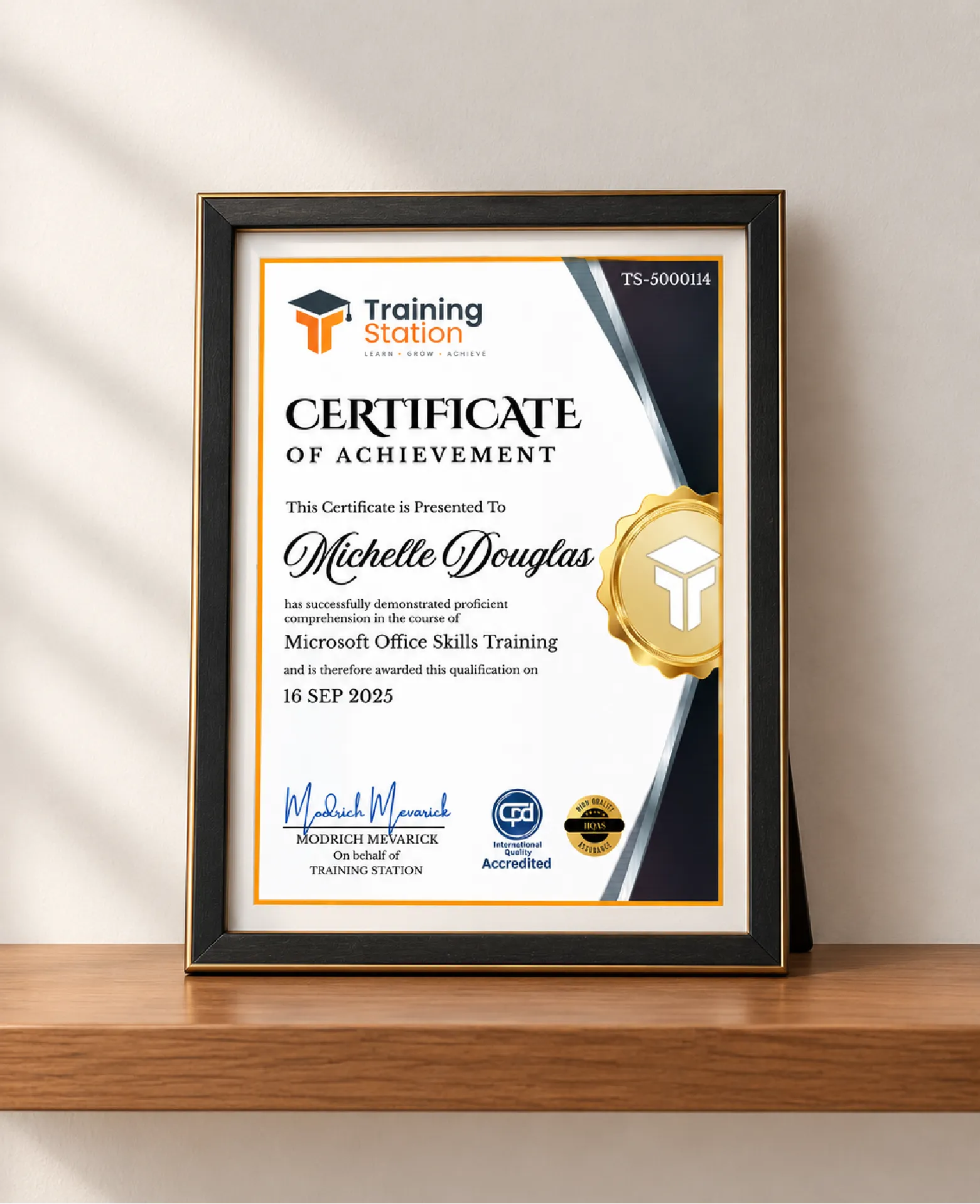
Celebrate your achievement with a CPD-IQ accredited certificate from Training Station! Perfect for showcasing your skills, boosting your career, and enhancing your professional profile.
Get this CourseOur Courses Accreditation





Frequently Asked Questions
Fully online through PDF materials and video lessons. Learn anytime, anywhere.
Self-paced: complete it in a week or spread it over months.
No. The course is beginner-friendly.
Yes. Instructor support is available Monday to Friday.
Yes. We offer a 14-day money-back guarantee.
 Access all courses for Only £99