
Claude AI Course: Prompt Engineering and Practical AI Skills

- Access
- Lifetime
- Assistance
- Expert Tutor Support
- Flexibility
- Learn Anytime, Anywhere
Overview
Artificial intelligence is changing how people research information, create content, organise work and solve everyday problems. AI assistants can help users generate ideas, summarise information, draft documents, analyse text and explore possible solutions. However, achieving useful results depends on understanding how to communicate with these tools, provide suitable context and evaluate the information they produce.
The Claude AI Course is designed to introduce learners to Claude, an AI assistant developed by Anthropic, and explain how it can be used across a range of personal, educational and professional activities. You will explore how to write effective prompts, provide clear instructions, refine responses and use AI assistance to support structured tasks.
The course focuses on practical applications rather than treating AI as a replacement for human judgement. You will consider how Claude can assist with writing, brainstorming, research preparation, summarisation, planning, learning and workplace productivity. You will also explore ways to organise complex requests into manageable steps and improve the quality of responses through follow-up instructions.
An important part of responsible AI use is understanding its limitations. AI-generated information may contain errors, incomplete explanations or outdated details. You will develop awareness of fact-checking, privacy, confidentiality, copyright considerations and the need for human review before using AI-generated material in important decisions or published work.
By completing the course, you can build a foundation in Claude AI and prompt engineering. The knowledge may help you use AI tools more effectively, improve everyday workflows and prepare for further learning in artificial intelligence and digital productivity.
This is an independent educational course about using Claude. It does not provide an official Anthropic certification or imply endorsement by Anthropic.
What You Will Learn
You will develop an understanding of:
-
What Claude AI is and how AI assistants work.
-
Navigating the available Claude interface and features.
-
Writing clear and effective prompts.
-
Providing context, instructions and examples.
-
Improving responses through follow-up prompts.
-
Using Claude for writing and content development.
-
Summarising and organising information.
-
Supporting research and problem-solving tasks.
-
Applying AI to productivity and workplace activities.
-
Recognising AI limitations and using it responsibly.
Course Modules
Module 1: Introduction to Claude AI and Artificial Intelligence
Explore the foundations of artificial intelligence and understand the role of conversational AI assistants. You will learn about Claude’s purpose and how users can interact with it through natural-language instructions. The module also introduces the opportunities and limitations of generative AI, helping you develop realistic expectations about what an AI assistant can and cannot do.
Module 2: Getting Started with Claude
Develop an understanding of the Claude user experience and the basic steps involved in starting a conversation. You will explore how to enter questions, provide instructions and review generated responses. You will also consider how available features may differ according to account type, region and product updates.
Module 3: Prompt Engineering Fundamentals
Learn how to write prompts that communicate your requirements clearly. You will explore the importance of context, task descriptions, desired outputs, constraints and examples. The module explains why vague requests can produce less useful responses and how more specific instructions can improve relevance.
Module 4: Advanced Prompting and Response Refinement
Develop a more structured approach to prompting. You will explore multi-step instructions, role and perspective requests, output formats, examples and follow-up questions. You will also learn how to review an initial response, identify missing information and refine your instructions to achieve a more suitable result.
Module 5: Claude AI for Writing and Content Creation
Explore how Claude can assist with brainstorming, outlining, drafting, editing and rewriting. You will consider its potential uses for emails, reports, articles, descriptions and other written materials. The module also highlights the importance of maintaining an appropriate voice, checking factual claims and ensuring that the final content reflects your own requirements.
Module 6: Research, Summarisation and Information Organisation
Learn how AI can help organise complex information and produce summaries of supplied material. You will explore how to request comparisons, extract key points and organise information into structured formats. The module emphasises the need to verify sources and distinguish between information provided in a document and additional claims generated by the AI.
Module 7: Claude AI for Productivity and Workplace Tasks
Discover how Claude may support everyday professional activities. You will explore possible uses for planning, brainstorming, meeting preparation, task organisation, drafting standard communications and creating structured checklists. You will also consider how to review outputs before sharing them and how to ensure that AI assistance fits existing workplace procedures.
Module 8: Problem-Solving, Analysis and Learning Support
Explore how to use Claude to break down questions, compare options and explain unfamiliar concepts. You will learn how to ask for step-by-step explanations, request examples and identify assumptions that may need further checking. The module also considers how AI can support learning without replacing independent understanding or critical thinking.
Module 9: Responsible AI Use, Privacy and Accuracy
Understand why responsible AI use requires human oversight. You will explore inaccurate outputs, potential bias, sensitive information, confidentiality and copyright considerations. The module also highlights why personal, confidential or commercially sensitive information should not be entered into an AI tool unless the relevant privacy, security and organisational requirements have been checked.
Module 10: Building Practical AI Workflows and Continuing Development
Bring together your learning to design simple workflows that use Claude appropriately. You will consider how to combine prompts, review outputs, check information and refine results. The module also introduces ways to keep your knowledge current as AI products and features evolve.
Who Is This For?
This course is suitable for:
-
Beginners interested in Claude AI.
-
Students and independent learners.
-
Office and administrative professionals.
-
Business owners and entrepreneurs.
-
Content writers and marketers.
-
Freelancers and consultants.
-
Managers and team leaders.
-
Researchers and knowledge workers.
-
Anyone interested in prompt engineering and AI productivity.
It can also benefit people who have tried AI assistants but want to improve the clarity, relevance and usefulness of their prompts.
Requirements / Prerequisites
No formal qualifications or previous AI experience are required. Basic computer and internet skills will be useful, together with an interest in exploring digital tools.
Access to Claude may be helpful for practical exercises, subject to current account availability and any applicable usage limits. Features and access arrangements may change over time. Learners should use the service in accordance with its current terms and should never assume that AI-generated information is automatically accurate or suitable for professional use.
Skills You Can Develop
The course can help you develop:
-
AI literacy and tool awareness.
-
Prompt writing and refinement.
-
Clear instruction development.
-
AI-assisted writing and editing.
-
Information summarisation.
-
Research preparation.
-
Structured problem-solving.
-
Workplace productivity awareness.
-
Critical evaluation of AI outputs.
-
Responsible and privacy-conscious AI use.
Career Path and Professional Opportunities
Knowledge of AI assistants and prompt engineering can complement existing skills in many industries. Depending on your experience and wider qualifications, possible career directions include:
-
Administrative Assistant: Using AI tools to support routine drafting, planning and information organisation.
-
Content Assistant: Exploring AI-assisted content preparation and editing while maintaining human review.
-
Digital Marketing Assistant: Supporting brainstorming, campaign planning and content development.
-
Business Support Assistant: Using AI tools to organise information and prepare working documents.
-
Customer Service Assistant: Exploring AI-supported drafting of routine responses within approved organisational procedures.
-
Research Assistant: Using AI to help organise supplied information and prepare summaries, subject to source verification.
-
AI Workflow Assistant: Supporting the development and documentation of simple AI-assisted processes.
More specialised AI roles may require additional technical knowledge, data skills, programming ability or experience with AI systems. This course does not qualify learners as AI engineers, machine-learning specialists or professional prompt engineers.
Learning Outcomes
By completing the course, you should be able to explain the purpose of Claude AI, describe its common uses and interact with the tool using clearer instructions. You should understand how context, examples and output requirements can influence the quality of a response.
You should also be able to identify opportunities to use AI for writing, summarisation, planning and workplace productivity. Importantly, you will develop awareness of limitations, privacy considerations and the need to verify AI-generated information before relying on it.
Professional Development and Future Opportunities
AI literacy is increasingly relevant to digital productivity and modern workplace practices. You may wish to build on this foundation through further learning in prompt engineering, generative AI, business automation, data analysis, digital marketing or AI-assisted research.
Practical experience can help you understand where AI adds value and where human expertise remains essential. You can develop sample workflows for everyday tasks, document your prompts and compare AI-assisted outputs with independently checked information.
Take the Next Step
Develop practical knowledge of Claude AI and learn how to communicate with an AI assistant more effectively. Enrol in the Claude AI Course to build your prompt engineering skills, explore useful applications and understand how to use AI responsibly in everyday and professional tasks.
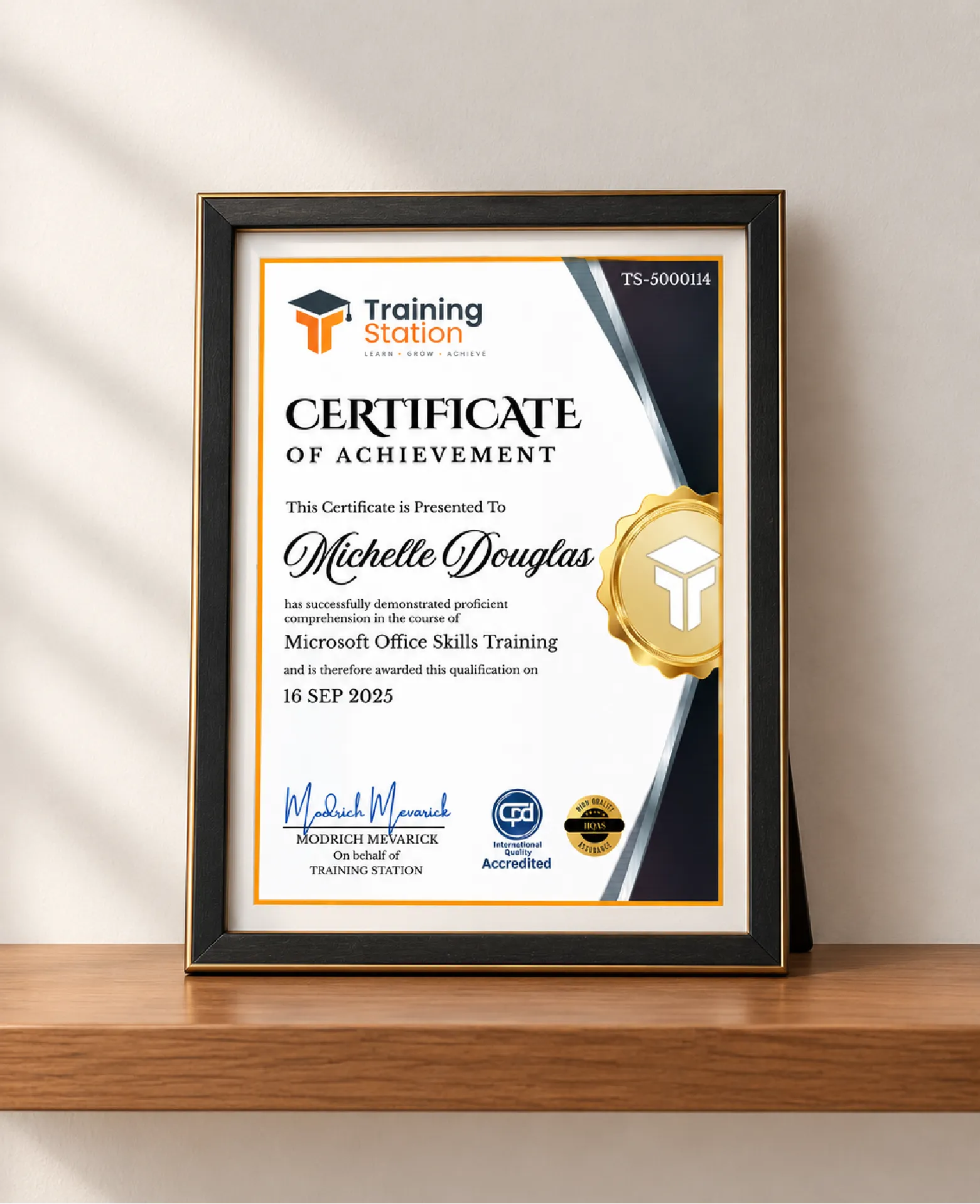
Celebrate your achievement with a CPD-IQ accredited certificate from Training Station! Perfect for showcasing your skills, boosting your career, and enhancing your professional profile.
Get this CourseOur Courses Accreditation






Frequently Asked Questions
Fully online through PDF materials and video lessons. Learn anytime, anywhere.
Self-paced: complete it in a week or spread it over months.
No. The course is beginner-friendly.
Yes. Instructor support is available Monday to Friday.
Yes. We offer a 14-day money-back guarantee.
 Access all courses for Only £99