
Motorbike Repairing and Maintenance Diploma
- Access
- Lifetime
- Assistance
- Expert Tutor Support
- Flexibility
- Learn Anytime, Anywhere
Overview
Motorbike Repairing and Maintenance Diploma
Get Ready to Build a Career in Motorbike Repairing and Maintenance
Develop essential motorcycle maintenance knowledge, understand motorbike engines and mechanical components, and build a strong foundation for exciting career opportunities in motorcycle servicing and repair!
✅ Understand Motorcycle Engine Fundamentals — Learn how motorcycle engines operate, explore essential mechanical components, and understand basic motorbike maintenance principles.
✅ Develop Motorcycle Systems Knowledge — Explore cooling and lubrication systems, ignition mechanisms, suspension components, and essential motorcycle operating systems.
✅ Build Fuel Systems & Tyre Maintenance Awareness — Understand motorcycle fuel delivery, fuel injectors, intake and exhaust systems, and essential tyre sizing principles.
✅ Explore Career Opportunities — Build foundational knowledge relevant to motorcycle maintenance, motorbike servicing, mechanical repair, and technical support roles in motorcycle workshops, dealerships, and servicing centres.
Course Overview
Explore the mechanical systems and maintenance principles associated with motorcycles through this Motorbike Repairing and Maintenance Diploma. The programme introduces essential motorcycle components and the role they play in vehicle operation and maintenance.
The curriculum begins with motorcycle maintenance fundamentals and essential checks, providing an introduction to the considerations involved in keeping motorcycle systems in working condition. It also examines engines, cooling and lubrication, exploring how these systems contribute to motorcycle performance and operation.
Further topics include ignition and suspension systems, alongside intake, fuel and exhaust components. Learners also examine fuel injectors and motorcycle tyres, including the importance of tyre specifications and sizing.
Designed for motorcycle enthusiasts and learners interested in mechanical maintenance, the course provides introductory knowledge of motorcycle systems and their relevance to routine maintenance and further technical learning.
Key Curriculum Topics
-
Motorcycle Maintenance Fundamentals and Essential Checks: Explore basic maintenance principles and the purpose of routine checks.
-
Motorbike Engines, Cooling and Lubrication: Understand the roles of engine, cooling and lubrication systems.
-
Ignition Systems and Suspension: Examine the functions of ignition and suspension components.
-
Intake, Fuel, Exhaust Systems and Fuel Injectors: Explore how these systems contribute to motorcycle operation.
-
Motorcycle Tyres and Sizing: Understand introductory tyre specifications and sizing considerations.
Course Curriculum
Module 1: Introduction to Motorbike Maintenance
Explore the fundamentals of motorbike maintenance and become familiar with the main subject areas involved in understanding and maintaining motorcycles.
Main learning topics:
-
Motorbike maintenance fundamentals
-
Motorcycle components
-
Maintenance essentials
-
Introduction to motorcycle systems
Module 2: Know Your Motorbike Engines
Learn about motorbike engines and their importance in motorcycle operation. This module introduces a central mechanical system that learners can explore further through technical study and practical experience.
Main learning topics:
-
Motorcycle engine fundamentals
-
Engine components
-
Engine operation
-
Engine maintenance awareness
Module 3: Engine Cooling and Lubrication
Study engine cooling and lubrication, two important areas of motorcycle engineering. Understand their roles in managing engine temperature and reducing friction between moving components.
Main learning topics:
-
Engine cooling systems
-
Engine lubrication
-
Temperature management
-
Friction and component protection
Module 4: Ignition
Explore motorcycle ignition systems and their role in supporting engine operation. This module introduces an important system for learners developing their understanding of motorcycle mechanics.
Main learning topics:
-
Ignition system fundamentals
-
Ignition components
-
Ignition and engine operation
-
Ignition maintenance awareness
Module 5: Suspension
Learn about motorcycle suspension and its contribution to handling, stability and riding comfort. This topic introduces a key motorcycle system relevant to maintenance and mechanical knowledge.
Main learning topics:
-
Motorcycle suspension
-
Suspension components
-
Handling and stability
-
Suspension maintenance awareness
Module 6: Intake, Fuel, and Exhaust Systems
Explore the intake, fuel and exhaust systems and understand how these systems contribute to the motorcycle engine’s operation.
Main learning topics:
-
Air intake systems
-
Fuel systems
-
Exhaust systems
-
Relationships between engine systems
Module 7: Fuel Injectors on a Motorcycle
Study motorcycle fuel injectors and their place within the fuel delivery system. This module introduces a specific component relevant to understanding modern motorcycle engine systems.
Main learning topics:
-
Motorcycle fuel injectors
-
Fuel injection fundamentals
-
Fuel delivery
-
Fuel system awareness
Module 8: Motorcycle Tyres and Sizing
Learn about motorcycle tyres and sizing. This module introduces an important aspect of motorcycle maintenance, helping learners become familiar with tyre specifications and their relevance to motorcycle suitability.
Main learning topics:
-
Motorcycle tyre types and specifications
-
Tyre sizing
-
Understanding tyre dimensions
-
Tyre maintenance awareness
Who Is This Course For?
The Motorbike Repairing and Maintenance Diploma is designed around foundational motorcycle maintenance knowledge and may be useful to learners interested in developing their understanding of motorbike systems.
-
Aspiring motorcycle mechanics: Explore engines, ignition, suspension, fuel systems and other subjects relevant to further mechanic training.
-
Motorcycle service technician applicants: Build introductory knowledge of motorcycle components before pursuing practical training and employer-specific requirements.
-
Motorbike enthusiasts: Understand the systems that contribute to motorcycle operation and become more familiar with basic motorbike maintenance.
-
Motorcycle owners: Learn about maintenance-related subjects such as engine lubrication, cooling, fuel injection and tyre sizing. Follow manufacturer guidance when maintaining your own motorcycle.
-
Motorcycle dealership staff: Develop technical awareness that may complement customer-facing work involving motorcycles and their components.
-
People considering a career change: Explore motorcycle mechanics as a potential career direction before committing to additional vocational training.
-
Learners interested in motorcycle repair workshops: Gain an introduction to relevant mechanical terminology and systems before seeking supervised workshop experience.
-
Beginners interested in vehicle maintenance: Develop foundational knowledge of motorcycle engines and supporting systems.
This course may also be useful to existing motorcycle enthusiasts who want to organise their knowledge of maintenance topics. It should not be treated as proof of practical repair competence or as a substitute for hands-on training.
Requirements
No formal entry requirements have been supplied for the Motorbike Repairing and Maintenance Diploma.
-
Previous motorcycle repair experience has not been specified as a requirement.
-
No academic qualifications have been stated.
-
No professional registration or licence requirements have been provided for enrolment.
The curriculum may be suitable for beginners interested in learning about motorcycle systems. Prior mechanical knowledge may be helpful but has not been identified as a formal requirement.
If you intend to work as a motorcycle mechanic, you should investigate relevant vocational training and practical experience opportunities. Always follow manufacturer instructions and appropriate safety procedures when working on motorcycles.
Skills You Can Develop
-
Motorbike maintenance awareness — Develop an understanding of the main subjects involved in motorcycle maintenance.
-
Engine system knowledge — Become familiar with motorcycle engines and their role in bike operation.
-
Cooling and lubrication awareness — Understand the purpose of engine cooling and lubrication systems.
-
Ignition system knowledge — Develop introductory knowledge of motorcycle ignition systems.
-
Suspension system awareness — Understand the role of suspension in motorcycle handling, stability and comfort.
-
Fuel system knowledge — Explore fuel systems and the role of motorcycle fuel injectors in fuel delivery.
-
Intake and exhaust system awareness — Understand the purpose of intake and exhaust systems in motorcycle engine operation.
-
Tyre specification awareness — Become familiar with motorcycle tyres and sizing terminology.
-
Mechanical terminology — Develop familiarity with the names and functions of the motorcycle systems covered in the curriculum.
-
Technical learning readiness — Build foundational subject knowledge that can support further study and supervised practical training.
These are knowledge areas supported by the supplied curriculum. Practical diagnostic ability, repair proficiency and professional competence require suitable hands-on learning and assessment.
Learning Outcomes
By the end of the course, learners should be able to:
-
Explain the purpose of basic motorbike maintenance and identify its main subject areas.
-
Describe the role of motorcycle engines in bike operation.
-
Explain the functions of engine cooling and lubrication systems.
-
Identify the purpose of motorcycle ignition systems.
-
Describe the role of suspension in motorcycle operation.
-
Explain the functions of intake, fuel and exhaust systems.
-
Describe the role of fuel injectors in motorcycle fuel delivery.
-
Recognise key terminology associated with motorcycle fuel injection.
-
Explain the importance of understanding motorcycle tyres and sizing.
-
Identify areas of motorcycle maintenance knowledge that may require further study and practical training.
Career Paths
The course introduces technical subjects that may be relevant to people exploring motorcycle maintenance and related roles. The salary ranges below are broad, indicative estimates for the UK rather than guaranteed earnings. Actual pay varies by location, employer, experience, specialisation and working hours.
Motorcycle Mechanic
Typical UK Salary: Approximately £24,000–£35,000 per year, depending on experience and employer.
How This Course May Be Relevant: The engine, ignition, cooling, lubrication, suspension and fuel system modules introduce subjects relevant to motorcycle mechanics. However, employers generally look for practical repair skills and may require relevant vocational training or experience. This course alone does not demonstrate professional mechanical competence.
Motorcycle Service Technician
Typical UK Salary: Approximately £24,000–£36,000 per year, depending on responsibilities and experience.
How This Course May Be Relevant: Knowledge of motorcycle engines, fuel injection, suspension and tyres may provide useful background for further technician training. Practical diagnostics, servicing procedures and safety-critical repairs require additional hands-on learning.
Motorcycle Workshop Assistant
Typical UK Salary: Approximately £20,000–£27,000 per year, depending on duties and employer.
How This Course May Be Relevant: The curriculum introduces motorcycle components and maintenance terminology that may help learners prepare for entry-level workshop opportunities. Specific duties depend on the employer, and technical tasks may require supervision or additional training.
Motorcycle Dealership Service Support
Typical UK Salary: Approximately £22,000–£30,000 per year, depending on the role and employer.
How This Course May Be Relevant: Understanding motorcycle engines, fuel systems, suspension and tyre specifications may provide useful technical background for service support roles. Some positions focus on administration or customer service rather than repairs, and additional skills may be required.
Motorcycle Parts Adviser
Typical UK Salary: Approximately £22,000–£30,000 per year, depending on experience and employer.
How This Course May Be Relevant: Familiarity with motorcycle systems and tyre sizing may help learners build technical vocabulary relevant to parts-related work. Product identification, stock systems and customer service may require separate training or workplace experience.
Career progression note: These roles have different entry requirements. The diploma provides an introduction to motorcycle maintenance topics, but it does not guarantee employment, establish professional repair competence or replace practical training.
FAQs
1. What is the Motorbike Repairing and Maintenance Diploma?
The Motorbike Repairing and Maintenance Diploma is an introductory course covering eight areas of motorcycle maintenance, including engines, cooling and lubrication, ignition, suspension, fuel systems, fuel injectors, and motorcycle tyres and sizing.
2. What will I learn in a motorbike maintenance course?
You will explore the main systems involved in motorcycle operation and maintenance. The curriculum covers engine fundamentals, cooling, lubrication, ignition, suspension, intake, fuel and exhaust systems, fuel injectors, and tyre sizing.
3. What are the basic motorbike maintenance essentials?
Basic motorbike maintenance commonly involves understanding the condition of tyres, the operation of key systems and the importance of following manufacturer maintenance guidance. This course introduces relevant subjects, including engines, cooling, lubrication, suspension, fuel systems and tyres. For actual maintenance tasks, consult the motorcycle manufacturer’s instructions.
4. Is this motorbike maintenance course suitable for beginners?
The supplied curriculum starts with an introduction to motorbike maintenance and progresses through major motorcycle systems. It may therefore suit beginners seeking foundational knowledge. No formal entry requirements have been provided, but practical repair work requires appropriate training and safety precautions.
5. What should be included in a motorbike maintenance checklist?
A practical motorcycle maintenance checklist will depend on the model and manufacturer. Common checks can include tyre condition and pressure, lights, brakes, chain condition where applicable, fluid levels and visible signs of leaks. Follow the manufacturer’s schedule and seek professional assistance for safety-critical concerns. The supplied curriculum covers relevant maintenance subjects but does not specify a dedicated checklist module.
6. What should a motorbike maintenance kit contain?
The contents of a motorbike maintenance kit depend on the motorcycle and the work being undertaken. Suitable items may include tools and equipment specified by the manufacturer, alongside appropriate protective equipment. This course introduces motorcycle systems but does not provide a specified maintenance kit or tool list.
7. Can this course help me become a motorcycle mechanic?
The course can provide foundational knowledge of motorcycle engines and related systems, which may support further learning towards a motorcycle mechanic role. However, professional work often requires practical experience, suitable vocational training and the ability to carry out repairs safely. Completing this course alone does not establish professional competence or guarantee employment.
Curriculum
- Introduction to Motorbike Maintenance
- Know Your Motorbike Engines
- Engine Cooling and Lubrication
- Ignition
- Suspension
- Intake, Fuel, and Exhaust Systems
- Fuel Injectors on a Motorcycle
- Motorcycle Tires and Sizing
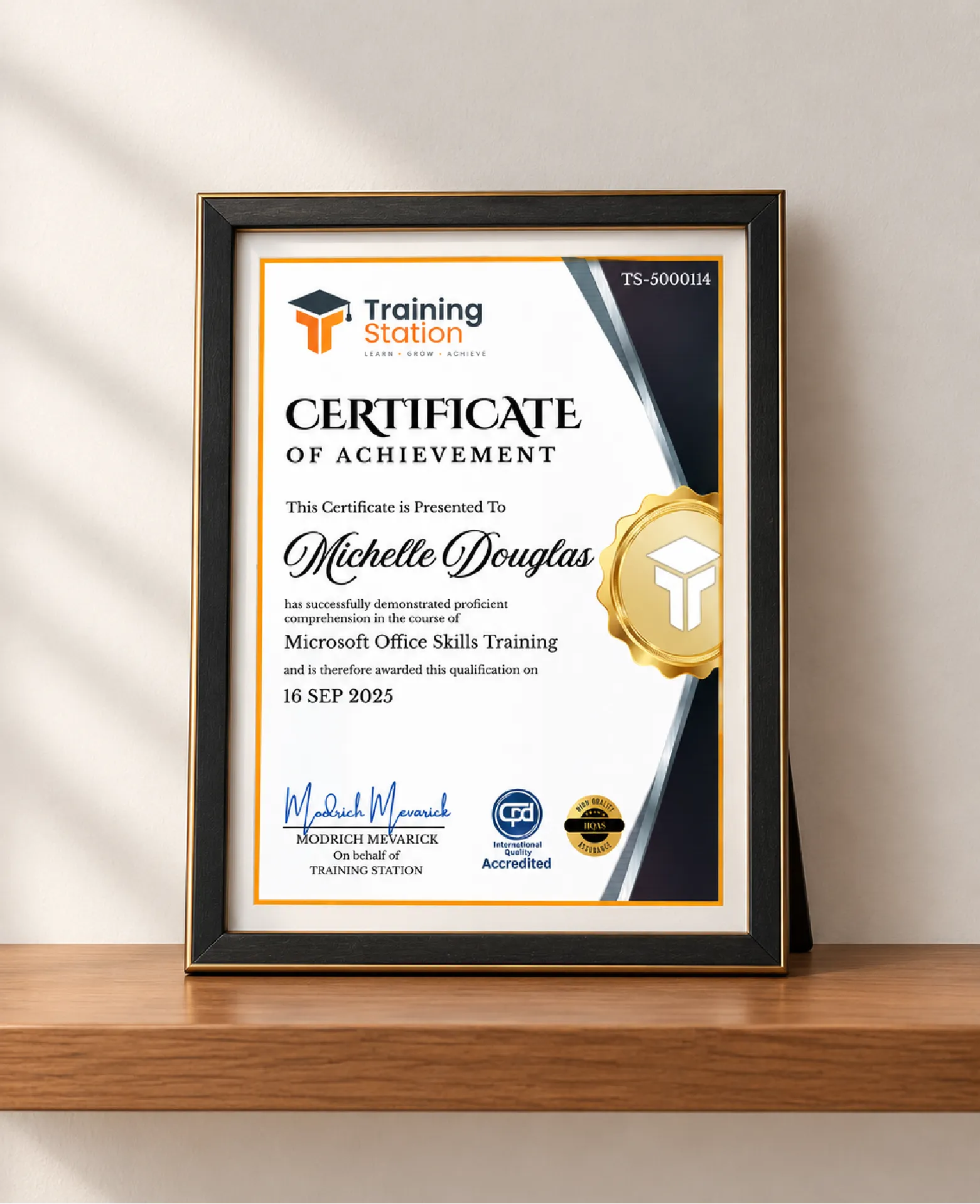
Celebrate your achievement with a CPD-IQ accredited certificate from Training Station! Perfect for showcasing your skills, boosting your career, and enhancing your professional profile.
Get this CourseOur Courses Accreditation


Frequently Asked Questions
Fully online through PDF materials and video lessons. Learn anytime, anywhere.
Self-paced: complete it in a week or spread it over months.
No. The course is beginner-friendly.
Yes. Instructor support is available Monday to Friday.
Yes. We offer a 14-day money-back guarantee.
 Access all courses for Only £99