
ChatGPT Prompt Engineering Course: Advanced Prompting Techniques

- Access
- Lifetime
- Assistance
- Expert Tutor Support
- Flexibility
- Learn Anytime, Anywhere
Overview
The ChatGPT Prompt Engineering Course is designed to help you develop the skills needed to communicate more effectively with ChatGPT through clear, structured and purposeful instructions. Prompt engineering is the practice of designing and refining the input given to an AI system so that its response is more relevant to the intended task. It is an important skill for people who want to use generative AI for writing, learning, research support, business communication and productivity.
A short or unclear prompt may produce a broad response that does not fully meet your needs. By learning how to provide context, define objectives, specify constraints and describe the expected output, you can guide an AI assistant towards more useful results.
Throughout this course, you will explore the foundations of effective prompting and develop a practical approach to creating prompts for different tasks. You will examine prompt structure, role and audience instructions, examples, formatting requirements, iterative refinement and multi-step requests.
You will also learn how to assess generated responses, identify weaknesses and improve your instructions. Importantly, the course will help you understand that prompt engineering does not guarantee accuracy. AI-generated information still requires appropriate checking, and human judgement remains essential.
By completing the training, you should be better prepared to create purposeful prompts, refine AI interactions and apply prompt engineering techniques across a variety of personal, educational and professional activities.
What You Will Learn
You will develop an understanding of:
-
What prompt engineering is and why it matters.
-
How ChatGPT interprets natural-language instructions.
-
The key components of a well-structured prompt.
-
Providing context, roles, objectives and constraints.
-
Writing prompts for different audiences and tasks.
-
Using examples to guide expected outputs.
-
Requesting specific formats and levels of detail.
-
Improving results through iterative prompting.
-
Structuring multi-step tasks and workflows.
-
Evaluating responses and identifying limitations.
-
Applying privacy and responsible-use principles.
Introduction to Prompt Engineering
You will begin by exploring the purpose of prompt engineering and how it influences interactions with generative AI. You will learn why the same AI system can produce very different responses depending on the information and instructions provided.
The course will introduce the relationship between a prompt, the model’s response and the user’s intended outcome. You will also examine why prompt engineering is not simply about finding special words. It involves communicating the task clearly and providing enough information for the AI to respond appropriately.
This foundation will help you understand how to approach prompts as practical instructions rather than vague questions.
Understanding the Structure of an Effective Prompt
You will explore the main components that can make a prompt more useful. These may include the task, context, audience, desired format, tone, constraints and examples.
You will learn how to combine these elements into a clear instruction. For example, a request to create content can become more specific by explaining who will read it, what information it should include and how the final result should be organised.
You will also examine how unnecessary details can make instructions harder to follow. The aim is to provide relevant context without making a prompt confusing or overloaded.
Roles, Objectives and Audience Instructions
You will learn how role and audience instructions can help establish the perspective and communication style required for a task.
You will explore how to describe the type of assistance you need, such as an editor, tutor, research assistant or business writing assistant. You will also learn to define the audience so that the response uses an appropriate level of detail and language.
The course will explain why role instructions guide the response but do not give the AI real-world professional qualifications or authority.
Context and Constraints
Context helps an AI assistant understand the situation behind a request. You will explore how to provide background information, relevant examples and the purpose of a task.
You will also learn how to use constraints to define what should or should not appear in a response. These may include word limits, formatting requirements, terminology, subject boundaries or style preferences.
You will consider why constraints should be clear and realistic. When instructions conflict, the output may not satisfy every requirement, so you will learn to review prompts for consistency before submitting them.
Prompting for Writing and Content Creation
You will explore how prompt engineering can support writing activities such as drafting, editing, rewriting, brainstorming and content planning.
You will learn how to request different tones, structures and levels of formality. You will also examine how to guide the development of articles, reports, emails, product descriptions and educational content.
The course will emphasise that AI-generated writing should be reviewed for accuracy, originality, relevance and suitability. A well-designed prompt can improve the draft, but it does not remove the need for human editing.
Prompting for Learning and Research Support
You will examine how prompts can help explain unfamiliar topics, organise study notes and break complex subjects into smaller concepts.
You will learn to request step-by-step explanations, comparisons, examples and revision questions. You will also explore how to ask for alternative explanations when an initial answer is difficult to understand.
For research-related tasks, you will consider how to request summaries and identify areas that need further investigation. You will learn why important facts must be checked against reliable sources rather than accepted simply because an AI response sounds convincing.
Advanced Prompting Techniques
You will be introduced to more structured prompting methods, including example-based prompting, task decomposition and requests that specify a sequence of steps.
You will explore how examples can demonstrate the style or structure you want the AI to follow. You will also learn how breaking a large task into smaller stages can make the process easier to review.
The course will discuss the general principles behind techniques often described as zero-shot and few-shot prompting. You will understand how these approaches use instructions and examples to guide the response.
Iterative Prompting and Response Refinement
A useful result may require several rounds of improvement. You will explore how to review an initial response and provide follow-up instructions that address specific weaknesses.
You will learn how to request greater detail, simplify explanations, correct misunderstandings, change the structure or adjust the tone. You will also consider why it is more effective to identify the exact problem than simply asking the AI to try again.
This process can help you develop a more deliberate approach to improving generated content.
Prompting for Structured Outputs
You will explore how to request information in formats that are easier to review and use. These may include headings, bullet points, tables, checklists, summaries and step-by-step instructions.
You will learn how to define the required structure and explain what information belongs in each section. You will also consider why structured outputs should be checked for missing information, incorrect relationships or formatting inconsistencies.
Multi-Step Tasks and Workflow Design
Some tasks involve several connected stages. You will explore how to use prompts to organise workflows such as planning a project, preparing a report or developing a content outline.
You will learn how to divide a task into stages, review intermediate results and provide additional information where needed. You will also examine the value of keeping a clear objective throughout the process.
This approach can help you use ChatGPT for more involved activities while maintaining control over the final result.
Evaluating Accuracy and Responsible Prompting
Prompt engineering can improve relevance, but it cannot guarantee that an answer is correct. You will explore common limitations of AI-generated content, including unsupported claims, missing context and inaccurate explanations.
You will learn to ask for assumptions and limitations where appropriate, verify important claims and distinguish between generated suggestions and confirmed information.
You will also consider privacy, confidentiality and responsible use. Avoid entering sensitive information unless the relevant data protections and organisational policies have been assessed.
Who Is This For?
This course is suitable for:
-
ChatGPT users who want to improve their prompting skills.
-
Beginners interested in generative AI.
-
Writers and content creators.
-
Digital marketing professionals.
-
Business owners and entrepreneurs.
-
Students and independent learners.
-
Administrative and office professionals.
-
Professionals who want to use AI more effectively at work.
Requirements / Prerequisites
No formal qualifications or programming experience are required. Basic computer and internet skills will be helpful.
Access to ChatGPT is recommended so that you can practise writing and refining prompts. Some features may depend on account access and current product availability.
An interest in experimenting with instructions, evaluating responses and improving written communication will help you gain more from the course.
Career Path
Prompt engineering is a transferable skill that may support further development in:
AI Content Assistant: Use structured prompts to support content drafting and organisation.
Digital Marketing Assistant: Apply prompting techniques to brainstorming, campaign planning and communication tasks.
Content Creator: Develop more consistent AI-assisted writing and editing workflows.
Administrative Professional: Use prompts to support document preparation and information organisation.
Business Support Assistant: Explore AI-assisted approaches to routine workplace tasks.
AI Workflow Specialist: Build further technical and process knowledge around AI-supported workflows.
These are possible applications of the skills covered, not guaranteed job outcomes. Specialist roles may require additional technical training, experience and demonstrable project work.
Your Learning Outcome
By completing this course, you should understand how to design clearer and more effective ChatGPT prompts. You will be better prepared to provide context, define output requirements, use examples, refine responses and organise multi-step tasks.
You will also develop a more critical approach to AI-generated content by recognising the need for accuracy checks, privacy awareness and human oversight. These skills can help you make more purposeful use of ChatGPT across a range of everyday and professional activities.
Curriculum
- Introduction to ChatGPT Plus Features
- Configuring Custom Instructions for Precision
- How ChatGPT Remembers Conversations
- Working with Pre-Built GPTs
- Creating Your Own Custom GPT
- Generating Images with DALL·E
- Understanding OpenAI Watermarking
- Using ChatGPT Plugins for Extended Functionality
- Converting Text to Audio with ChatGPT
- Creating Professional Audio with ElevenLabs
- Turning Text into Video with Pictory
- Understanding Meta AI Image Usage Policies
- YouTube’s Policies on AI-Generated Content
- Generating AI-Powered Document Summaries
- Google’s Position on AI Content and SEO
- Creating AI-Generated YouTube Summaries
- Developing Content for Your Own Projects
- Crafting Midjourney Prompts Using Three ChatGPT Methods
- Conclusion: Exploring the Full Capabilities of GPTs
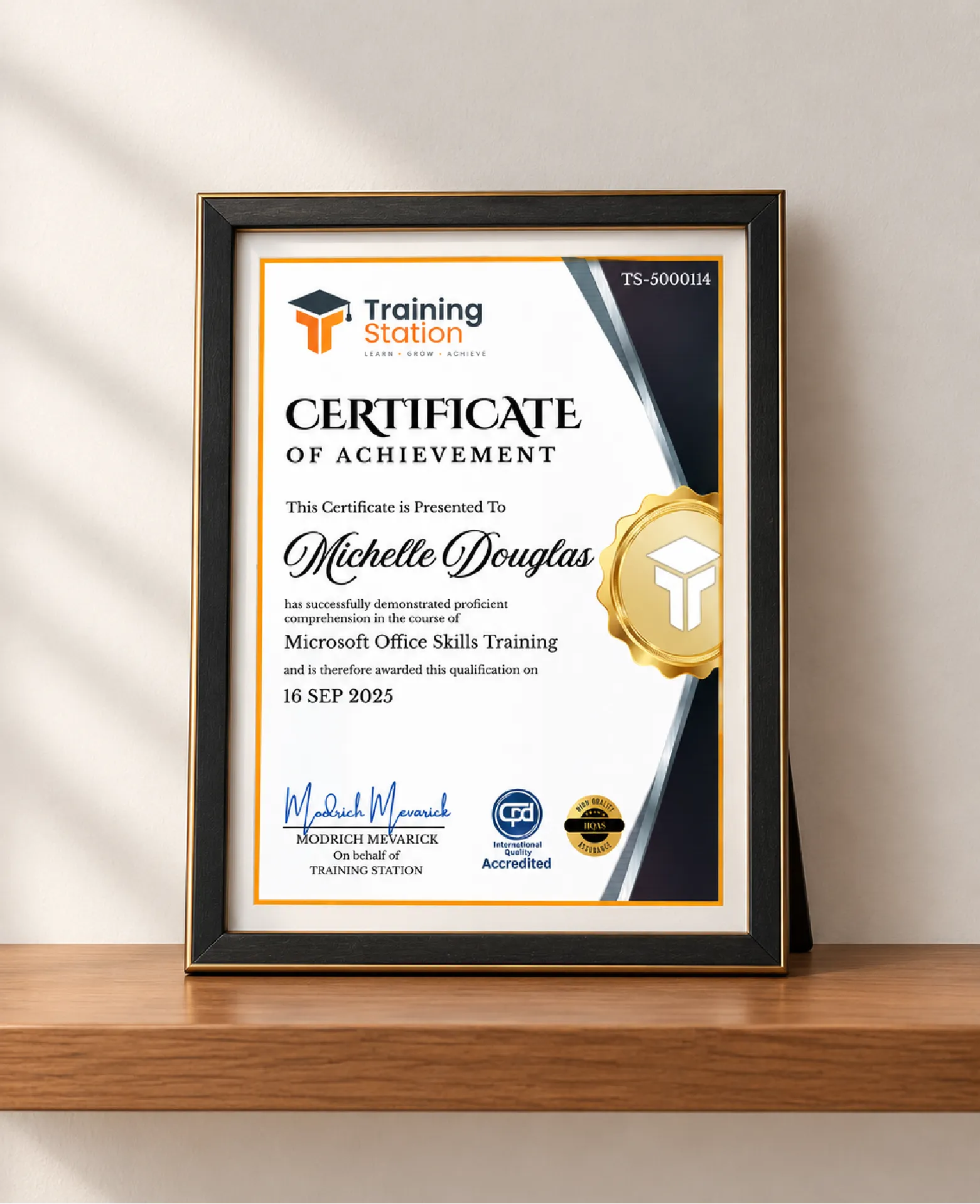
Celebrate your achievement with a CPD-IQ accredited certificate from Training Station! Perfect for showcasing your skills, boosting your career, and enhancing your professional profile.
Get this CourseOur Courses Accreditation






Frequently Asked Questions
Fully online through PDF materials and video lessons. Learn anytime, anywhere.
Self-paced: complete it in a week or spread it over months.
No. The course is beginner-friendly.
Yes. Instructor support is available Monday to Friday.
Yes. We offer a 14-day money-back guarantee.
 Access all courses for Only £99